
Reverse Aging
Thread Lifting
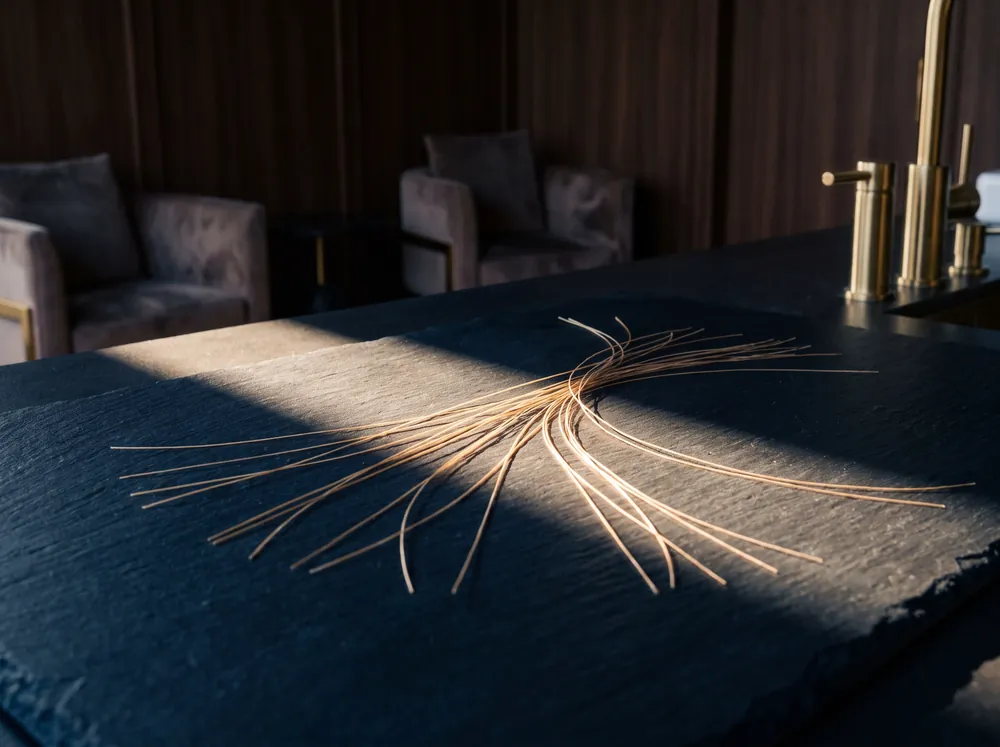
Thread lifting uses absorbable threads to move sagging tissue directly. We first confirm whether there is tissue to lift and where it can be anchored, then proceed.
Thread Lifting
Thread Lifting
Treatments that tighten with heat and thread lifting serve different purposes. Heat contracts tissue slowly from within, while threads move already sagging tissue directly upward. Laplace first draws the direction of the sagging and the anchor points on the face, then uses only as many threads as that plan requires.
Recommended for
- Those who see a clear direction to the sagging in the cheeks
- Those who felt that thermal lifting alone was not enough
- Those who want a change in contour within a short recovery period
- Those who want a softened jawline defined again
- Those hesitant about surgery who still want a lifting effect
Our View
How we see it at Cheongdam Laplace
The process
01
Vector design
We draw the point where the sagging begins and the direction of the lift directly on the face, reviewing and adjusting it together.
02
Preparing local anesthesia
Local anesthesia is given along the path the threads will follow, lowering the pain and tension felt during the procedure.
03
Thread insertion and lift
Threads are placed in the planned layer with a cannula, and the degree of lift is fine-tuned while symmetry is checked.
04
Finishing and guidance
After smoothing any irregularity on the surface, we explain in detail how to manage eating and facial expressions during the recovery period.
Treatment information
| Treatment time | About 30-60 minutes depending on the number of threads |
|---|---|
| Anesthesia | Topical anesthetic followed by local anesthesia |
| Recovery | Swelling and bruising usually 1-2 weeks (varies by individual) |
| Recommended interval | Reassessment usually every 12-18 months |
| Treatment areas | Cheeks · Jawline · Under-chin · Forehead (partial selection available) |
Frequently asked questions
Do the threads stay in the body?
The threads used are made of a material that breaks down and is absorbed in the body over time. The absorption period depends on the material, and the tissue response formed around them is known to maintain support for a certain period even after the threads are gone.
What should I be careful about during recovery?
For about two weeks it is better to avoid meals that require opening the mouth wide, strong facial expressions, and facial massage. Sleeping on your side can also affect the difference between the two sides early on, so we cover that as well.
Will it be very noticeable?
Right after insertion you may feel tightness and slight irregularity, but this usually eases over 1-2 weeks. In areas where the skin is thin the threads can show through, so we adjust the insertion layer and number in advance.
Can I have it together with Ulthera or Sofwave?
They are sometimes planned together, but the timing is separated. Thermal energy applied before the threads settle can affect them, so we usually leave an interval after thread lifting before setting the timing for thermal lifting.
Precautions and possible side effects
- Swelling, bruising, and a pulling pain may appear along the insertion path for 1-2 weeks.
- Depressions, dimpling, or slight irregularity may appear on the skin surface.
- A difference in the degree of lift between the two sides may feel asymmetric.
- Thread exposure, infection, foreign-body reaction, and persistent pain are reported rarely.
- Temporary reduced sensation or a tingling feeling may continue for several weeks.
- Please let us know in advance if you have a bleeding tendency or are taking anticoagulants.
- It is not performed, or is judged with particular care, during pregnancy and breastfeeding, where there is infection or acute inflammation in the treatment area, or where there is a history of keloid or hypertrophic scarring.
Treatment results may vary depending on individual condition, and side effects may occur. Please confirm the details through a consultation with our medical staff.
Consultation comes first
Before deciding on a treatment, let us look at your current condition together.